@directive-run/claude-plugin
officialClaude Code plugin for Directive — 12 skills covering modules, constraints, resolvers, derivations, AI orchestration, and adapters. Installable via Claude Code's plugin marketplace or consumable programmatically as an npm package.
Directive
The constraint-driven runtime for TypeScript. Declare what must be true. The runtime makes it happen.




- Constraint-Driven Resolution – declare requirements, resolvers fulfill them automatically with retry, batching, and error boundaries
- AI Guardrails – prompt injection detection, PII redaction, cost tracking, multi-agent orchestration with 4 LLM adapters (zero SDK dependencies)
- Auto-Tracking Derivations – computed values that track their own dependencies, no manual dep arrays
- Typed Inbound Sources – declare external event streams (Supabase, WebSocket, polling, browser events) as first-class module fields; engine owns the subscription lifecycle
- 5 Framework Adapters + 1 Vanilla – React, Vue, Svelte, Solid, Lit, plus
el()for plain DOM – from a single state layer - Zero Runtime Dependencies – nothing to audit, nothing to break
- Time-Travel Debugging – snapshot, rewind, replay, export/import system state
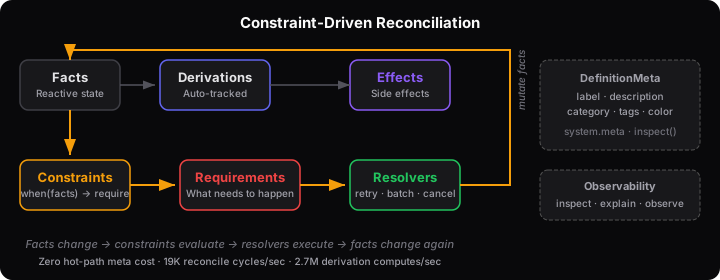
How It Works
Other state libraries react to what happened. Directive enforces what must be true.
// Traditional: describe HOW to change state
dispatch({ type: 'FETCH_USER', id: 123 });
// then write a thunk, saga, or effect to handle it...

// Directive: declare WHAT must be true
constraints: {
  needsUser: {
    when: (facts) => facts.userId > 0 && !facts.user,
    require: { type: "FETCH_USER" },
  },
}
// The runtime handles when, how, retry, and error recovery.
Set userId = 123 and the constraint fires, the resolver fetches the user, and the system settles – automatically.
Quick Start
npm install @directive-run/coreimport { createModule, createSystem, t, type ModuleSchema } from '@directive-run/core';
const userModule = createModule("user", {
schema: {
facts: {
userId: t.number(),
user: t.object<{ id: number; name: string } | null>(),
},
derivations: { isLoggedIn: t.boolean() },
events: {},
requirements: { FETCH_USER: {} },
} satisfies ModuleSchema,
init: (facts) => {
facts.userId = 0;
facts.user = null;
},
constraints: {
needsUser: {
when: (facts) => facts.userId > 0 && facts.user === null,
require: { type: "FETCH_USER" },
},
},
resolvers: {
fetchUser: {
requirement: "FETCH_USER",
resolve: async (req, context) => {
const res = await fetch(`/api/users/${context.facts.userId}`);
context.facts.user = await res.json();
},
},
},
derive: {
isLoggedIn: (facts) => facts.user !== null,
},
});
const system = createSystem({ module: userModule });
system.start();
system.facts.userId = 123; // Constraint fires automatically
await system.settle(); // Wait for resolution
console.log(system.facts.user); // { id: 123, name: "John" }AI Guardrails and Orchestration
The same constraint-driven model powers AI agent safety. Guardrails are constraints. Agent runs are resolvers. The runtime enforces them automatically.
npm install @directive-run/aiimport { createAgentOrchestrator } from '@directive-run/ai';
import { createAnthropicAdapter } from '@directive-run/ai/anthropic';
const orchestrator = createAgentOrchestrator({
agent: {
name: "assistant",
model: createAnthropicAdapter({ model: "claude-sonnet-4-5-20250514" }),
systemPrompt: "You are a helpful assistant.",
},
guardrails: {
input: [promptInjectionGuardrail(), piiGuardrail()],
output: [contentModerationGuardrail()],
},
budget: { maxTotalCost: 1.00 },
});- 4 LLM adapters – OpenAI, Anthropic, Ollama, Gemini (pure
fetch, zero SDK deps) - Built-in guardrails – PII redaction, prompt injection, content moderation, rate limiting
- Multi-agent patterns – parallel, sequential, supervisor, debate, DAG, goal-driven
- Cost tracking + budget enforcement – per-agent and per-system limits
- Streaming with backpressure – real-time token streaming with inline constraint evaluation
AI tooling: your assistant speaks Directive
Directive ships its own knowledge to your AI assistant, so generated code is idiomatic on the first try.
In Claude Code — two commands install the plugin (12 model-invoked skills):
/plugin marketplace add directive-run/directive
/plugin install directive@directive-plugins
In Cursor, Copilot, Windsurf, Cline, or OpenAI Codex — one command generates the rules file each assistant expects:
npx directive ai-rules initFor LLM agents that crawl docs at runtime — point at directive.run/llms.txt for the comparison framing + full sitemap.
The knowledge ships from a single source (@directive-run/knowledge). See the IDE Integration guide for the decision tree across all install paths.
React Integration
npm install @directive-run/reactimport { useFact, useDerived } from '@directive-run/react';
function UserProfile({ system }) {
const user = useFact(system, "user");
const isLoggedIn = useDerived(system, "isLoggedIn");
if (!isLoggedIn) return <p>Please log in</p>;
return <p>Hello, {user?.name}!</p>;
}Framework Support
| Framework | Package | Style |
|---|---|---|
| React | @directive-run/react | Hooks with useSyncExternalStore |
| Vue | @directive-run/vue | Composables with reactive refs |
| Svelte | @directive-run/svelte | Stores with $ syntax |
| Solid | @directive-run/solid | Signals with fine-grained reactivity |
| Lit | @directive-run/lit | Reactive Controllers for Web Components |
Why Directive?
| Redux | Zustand | XState | Directive | |
|---|---|---|---|---|
| Constraint-driven resolution | Yes | |||
| Auto-tracking derivations | Yes | |||
| AI guardrails + orchestration | Yes | |||
| Retry, batching, error boundaries | Manual | Manual | Manual | Built-in |
| Time-travel debugging | Extension | Partial | Built-in | |
| Framework-agnostic (6 adapters) | React only | React only | Any | Any |
| Zero runtime dependencies | Yes | Yes | ||
explain() – why does this state exist? | Yes |
Packages
| Package | Description |
|---|---|
@directive-run/core | Core runtime – modules, systems, plugins, testing |
@directive-run/react | React hooks (useFact, useDerived, useSelector, etc.) |
@directive-run/vue | Vue composables with reactive refs |
@directive-run/svelte | Svelte stores with $ syntax |
@directive-run/solid | Solid signals with fine-grained reactivity |
@directive-run/lit | Lit reactive controllers |
@directive-run/ai | AI orchestration, guardrails, multi-agent |
@directive-run/el | Vanilla DOM adapter (el(), JSX, htm) |
@directive-run/query | Declarative data fetching with causal cache invalidation |
@directive-run/cli | directive CLI – init, new, rules, tune, and more |
@directive-run/mutator | Transactional fact mutations with rollback |
@directive-run/optimistic | Optimistic UI updates layered over Directive systems |
@directive-run/timeline | Time-travel debugging panel |
@directive-run/vite-plugin-api-proxy | Vite dev-server proxy for AI providers (CORS + key handling) |
@directive-run/knowledge | Knowledge files consumed by AI assistants and editors |
@directive-run/claude-plugin | Claude Code plugin – 12 skills built from the knowledge package |
Documentation
Contributing
See CONTRIBUTING.md for development setup and architecture overview. A CLA signature is required for all contributions.
License
MIT OR Apache-2.0 – your choice.