flow-next
githubSpec-driven AI workflow plugin for Claude Code, OpenAI Codex, and Factory Droid. Zero-dep task tracking, worker subagents, Ralph autonomous mode, cross-model reviews.
Flow-Next






Repeatable agentic engineering.
The workflow layer for AI coding agents: durable specs, re-anchored workers, adversarial reviews, receipts.
Everything lives in your repo. Zero external dependencies. Uninstall: rm -rf .flow/.
📖 Full doc index → · 🌐 flow-next.dev · 👥 Teams guide · 💬 Discord
Why this exists
Agentic engineering compresses implementation from weeks to hours — and quietly removes every safety valve pre-agentic Agile relied on. The standups, the hallway clarification, the mid-flight course correction that used to finish a vague ticket over a two-week cycle: gone. When an agent can ship the task in one sitting, a rough ticket plus a chat scrollback is the whole work surface.
That work surface fails predictably. Agents drift mid-task, forget requirements, overfit to recent context, and hand reviewers 10K-line diffs with no focus signal. The bottleneck didn’t disappear — it moved upstream, to requirements, review, and verification. The spec has to carry the weight.
Flow-Next fixes the operating model, not just the prompt. It turns rough intent into durable specs, specs into context-sized task graphs, task graphs into re-anchored worker runs, and implementation into reviewed PRs with receipts. Between idea and merge it defines six named handover objects — each reviewable on its own, verified by a different model, and frozen at handover.
The artifact chain is not bureaucracy. It is the conversation that would otherwise be missing.
What you get
Flow-Next is an AI agent orchestration plugin: 28 agent-native skills covering the full lifecycle — idea → spec → tasks → review → ship → maintain — layered on a bundled pure-stdlib Python CLI (flowctl). The host agent is the intelligence; flowctl is the deterministic plumbing. No external services, no SaaS, no global config.
| Tenet | What it means |
|---|---|
| Spec-driven | Intent survives the chat. The unit of work is the spec — not the ticket, not the transcript, not the PR title. One durable document at .flow/specs/<id>.md, evolving through layers. |
| Context-fit planning | Right-sized task slices. Specs decompose into dependency-ordered tasks, each sized to one fresh ~100k-token context window. |
| Re-anchored work | Fresh context per task. Every worker subagent re-reads the spec, the task, and git state before touching code — no token bleed, no stale assumptions. |
| Adversarial gates | Fix until SHIP. A different model (RepoPrompt / Codex / Copilot) reviews every plan and every implementation. Different models make different mistakes — the disagreement surface is where the gaps live. |
| Receipts | ”Done” means there is proof. Commits, tests, review verdicts, and evidence recorded per task — never narration. |
| Multi-harness | One workflow everywhere. First-class on Claude Code, OpenAI Codex, and Factory Droid; runs on Grok Build and Cursor; community OpenCode port. |
| Self-improving | Compounds as you work. Memory, glossary, decision records, and strategy grow as side-effects of the workflow you already run — no manual “refresh” ceremony, ever. |
And one tenet about trust: everything lives in your repo under .flow/. Specs, tasks, memory, receipts — all of it is yours, in git, code-reviewable. Uninstall is rm -rf .flow/.
Quick start
Install
| Claude Code | OpenAI Codex | Factory Droid |
|
|
|
Why a script for Codex? Codex’s plugin protocol only registers skills from plugin.json — not custom .toml agents or hooks. install-codex.sh merges all 21 agents + hooks into ~/.codex/config.toml. Idempotent — safe to re-run. Full platform matrix + community ports in docs/platforms.md.
Grok Build (xAI)? If flow-next is already installed in Claude Code, Grok Build picks it up automatically — grok inspect shows the skills + hook loaded, zero extra setup. The /flow-next:* commands run when typed and the multi-agent flows work (a full /flow-next:plan fanned out all seven scout subagents end-to-end, verified). Grok’s slash autocomplete + grok inspect just under-list flow-next’s commands/agents — cosmetic, they work when invoked. (Don’t grok plugin install the repo — it’s a marketplace, not a single plugin.) See docs/platforms.md.
The 5-command happy path
/flow-next:capture                   # 1. Synthesize conversation → .flow/specs/<id>.md
/flow-next:plan <spec-id>            # 2. Break the spec into dependency-ordered tasks
/flow-next:work <spec-id>            # 3. Execute tasks in fresh-context worker subagents
/flow-next:make-pr <spec-id>         # 4. Render a cognitive-aid PR body (9 input streams)
/flow-next:resolve-pr <PR#>          # 5. Fetch review threads → triage → resolve
That’s the inner loop. Branch in (/flow-next:prospect for ranked candidates, /flow-next:interview for structured discovery), branch out (/flow-next:pilot + /flow-next:land for the autonomous assembly line, /flow-next:ralph-init for hardened overnight runs, /flow-next:audit for memory garbage collection).
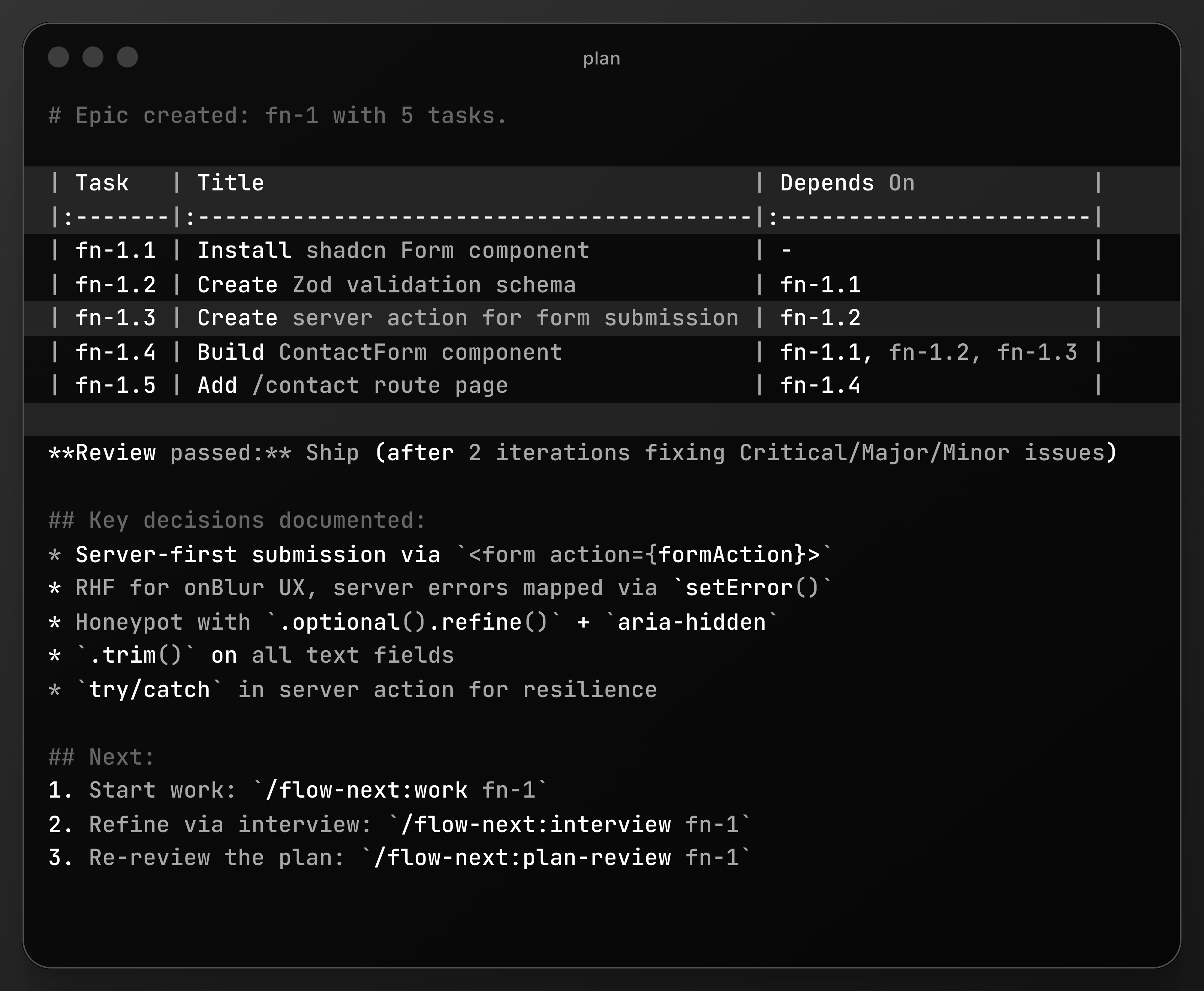
A /flow-next:plan result: dependency-ordered tasks, cross-model review iterated to SHIP, key decisions documented.
How the flow works
flowchart LR
    Idea([💡 Idea]) --> P[/flow-next:prospect/]
    Idea --> C[/flow-next:capture/]
    P --> C
    P -.->|direct via promote| L[/flow-next:plan/]
    C --> L
    C --> I[/flow-next:interview/]
    I --> L
    L --> W[/flow-next:work/]
    W --> R[/flow-next:impl-review/]
    R -->|SHIP| Q[/flow-next:qa/]
    R -->|NEEDS_WORK| W
    Q -->|YES| Done([🚀 Ship])
    Q -->|NO| W

    Done -.maintenance.-> A[/flow-next:audit/]
    A -.-> M[(.flow/memory/)]
/flow-next:qais an opt-in live-app QA stage (after work / around make-pr) — it drives the deployed app like a real user and only runs when there’s a live deploy + a driver; with neither it surfaces the limitation rather than blocking.
The loop is spec-driven. Each step below maps to one skill; click through to flow-next.dev for the full page.
1. Capture or prospect a spec
Either synthesize an existing conversation into a structured spec, or — when starting from scratch — generate ranked candidate ideas grounded in the repo. Both land in .flow/specs/<id>.md. Capture source-tags every acceptance criterion as [user] / [paraphrase] / [inferred] and runs a mandatory read-back — you see exactly how much of the spec the agent invented before anything is written.
/flow-next:capture                    # from a conversation
/flow-next:prospect <focus-hint>      # from a focus hint (concept, path, constraint, volume)
→ flow-next.dev/skills/capture · flow-next.dev/skills/prospect
2. Interview to refine
Deep Q&A pass over a spec or task: lead-with-recommendation, confidence tiers, codebase-first investigation. Use it to flesh out an ambiguous spec before breaking it down. --scope=business|technical|both symmetrically narrows the pass — the same skill serves the PO filling the business layer and the tech lead filling the technical layer, on the same spec file.
/flow-next:interview <spec-id>→ flow-next.dev/skills/interview
3. Plan into dependency-ordered tasks
Research the codebase via parallel scouts, then write the spec + tasks together. Tasks fn-N.M declare blockers, inherit context from the parent spec, and declare which acceptance criteria they satisfy (satisfies: [R1, R3]). This skill does not write code — only the plan.
/flow-next:plan <spec-id> # or <free-form text>4. Work through the tasks
Execute tasks systematically: each runs in a fresh-context worker subagent, re-anchors against the spec before starting, then implements + commits + records evidence. Cross-model review gates (impl-review, plan-review) wrap the loop and iterate until SHIP.
/flow-next:work <spec-id> # or <task-id>5. Open the PR with a cognitive-aid body
Don’t ask a human to skim a 10K-line diff. /flow-next:make-pr renders a PR body from nine flow-next input streams (spec R-IDs, per-task evidence, memory hits, glossary changes, strategy alignment, deferred review findings, the diff itself) — with an R-ID coverage table mapping every acceptance criterion to its satisfying task and evidence commit, and a “where to look” list that tells the reviewer which lines matter.
/flow-next:make-pr <spec-id> # auto-detects from current branchWith HTML artifact mode on (flowctl config set artifacts.html.enabled true), make-pr also commits a self-contained pr.html review instrument — diff-derived churn map, R-ID → evidence table with flagged mismatches, where-to-look checklist — and links it from the PR body. Same switch gives capture/plan a spec visualizer. Opt-in; see docs/html-artifacts.md.
→ flow-next.dev/skills/make-pr
6. Resolve PR review feedback
Fetch unresolved threads + top-level comments + review-submission bodies, cluster them, dispatch per-thread resolver agents (parallel on Claude Code, serial elsewhere), validate, commit, then reply + resolve via GraphQL.
/flow-next:resolve-pr <PR#>→ flow-next.dev/skills/resolve-pr
Going autonomous
Three loops, one quality bar. Multi-model review at every handover, don’t-thrash reflexes (two-strike unready, auto-block, bounded CI fix budgets), evidence over narration — invariant across all three. That’s the differentiator from “ralph-wiggum”-style loops that run open-loop without gates.
The default path is the pilot + land pipeline — in-session, host-driven, zero scaffold:
flowctl spec ready fn-12          # bless work (or move its issue on the tracker board)
/loop 10m /flow-next:pilot        # build loop: ready spec → plan → reviews → work → draft PR
/loop 30m /flow-next:land         # ship loop: draft PR → CI green → reviews converged → merged → released
Run both concurrently — two instances, separate clones — and you have the full assembly line: board → pilot → draft PR → land → released. The ready flag (or your tracker’s board state) is the consent boundary: humans bless specs, loops drain them. 📖 Going autonomous
Ralph is the hardened harness for fully planned specs (it never plans): an external shell loop drives a fresh session per iteration — failed attempts die with the session instead of polluting the next one — with hook-enforced guardrails and receipts on disk. Reach for it when a run outlasts a session or prose guardrails aren’t enough.
/flow-next:ralph-init           # One-time setup
scripts/ralph/ralph.sh          # Run from terminal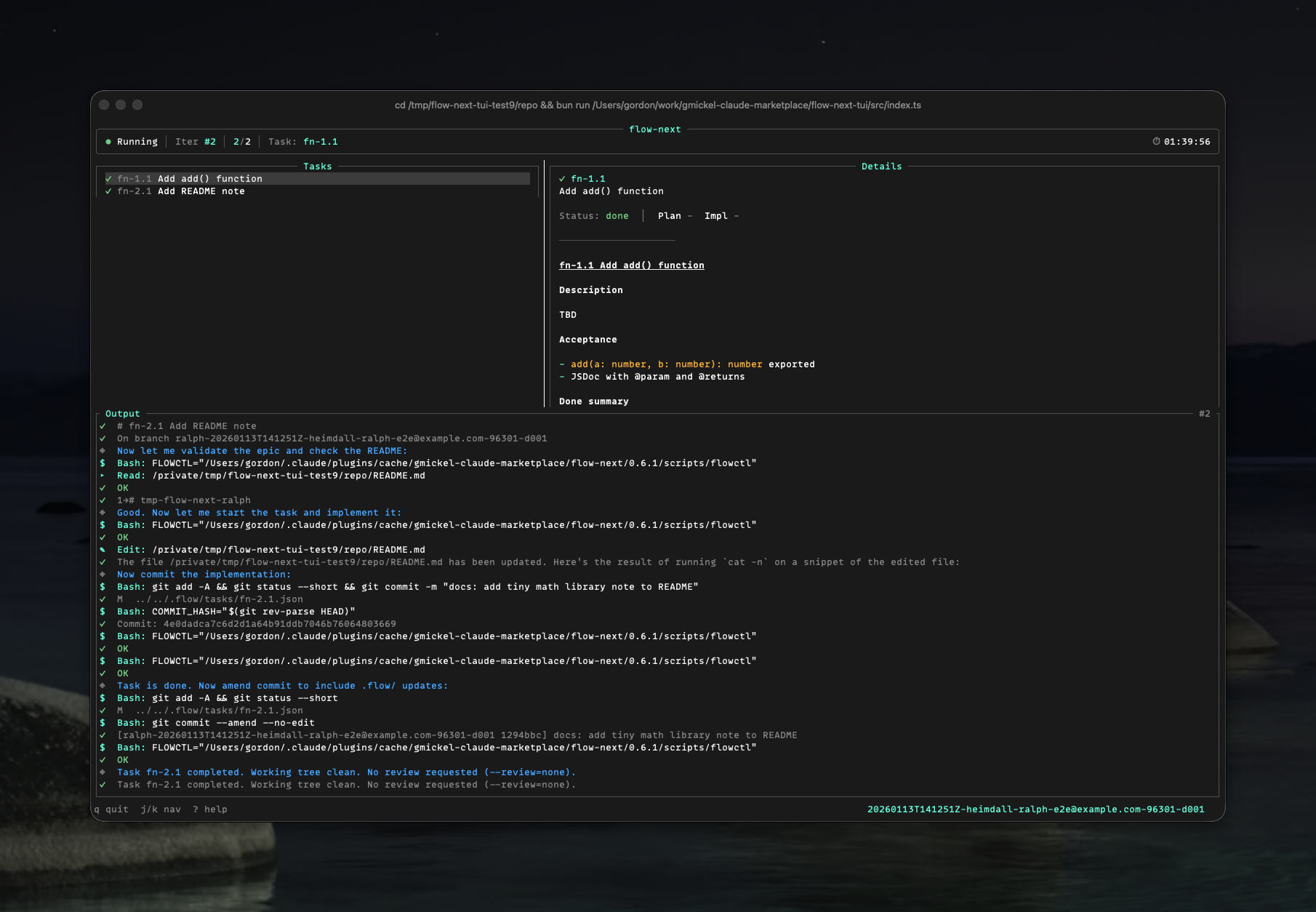
Ralph mode at night, PRs in the morning. The TUI tracks task progress, streaming logs, and run state.
📖 Ralph deep dive · Ralph TUI (bun add -g @gmickel/flow-next-tui)
Why it works
| Problem | Solution |
|---|---|
| Context drift | Re-anchoring before every task — re-reads specs + git state |
| Context window limits | Fresh context per task — worker subagent starts clean |
| Single-model blind spots | Cross-model reviews — RepoPrompt, Codex, or Copilot as second opinion |
| Forgotten requirements | R-IDs frozen at handover — numbered once, never renumbered; traced spec → task → commit → PR coverage table |
| ”It worked on my machine” | Evidence recording — commits, tests, PRs tracked per task |
| Infinite retry loops | Auto-block stuck tasks — fails after N attempts, moves on |
| Duplicate implementations | Pre-implementation search — worker checks for similar code before writing new |
| Hallucinated specs from “I think we discussed…” | Source-tagged capture — every acceptance criterion marked [user] / [paraphrase] / [inferred], mandatory read-back loop |
| Stale project memory polluting future work | /flow-next:audit + categorized memory schema — agent reviews each entry, flags stale (never deletes) |
| 10K-line diffs with no focus signal | PR-as-cognitive-aid — R-ID coverage, critical changes, decisions, where-to-look |
| GitHub PR review threads piling up | /flow-next:resolve-pr — fetch → triage → dispatch resolver agents → reply → resolve via GraphQL |
“Flow-next is simply the best coding flow, not even close.” — Tiago Freitas
“The re-anchoring is the quiet superpower. After a long session the agent still knows exactly what it’s building.” — @dailyreader
“Ralph mode at night, PRs in the morning. Zero drama. The receipts mean I trust what landed.” — @mfeighery
What Flow-Next is not
Scope honesty, because the architecture depends on it:
- Not a hosted dashboard or SaaS tier. Everything is in the repo; a hosted layer would break the uninstall promise.
- Not a Jira/Linear replacement for human-only teams. Flow-Next is for agentic-engineering teams. If your team lives in a tracker,
/flow-next:tracker-syncprojects specs to it — projection, not coordination: the spec stays the source of truth; the tracker never drives flow state or spawns agents. (Contrast OpenAI Symphony, where the tracker is the control plane — Flow-Next is “Symphony, but with real specs, re-anchoring, and receipts.”) - Not split-file specs. One durable spec document evolving through layers — vs. Kiro-style
requirements.md/design.md/tasks.mdfragmentation. - Not a replacement for human judgment. Humans own product decisions, risk tolerance, merge decisions, and production responsibility. Flow-Next makes those decisions easier to verify because the evidence is structured.
Commands
| Command | What it does |
|---|---|
/flow-next:strategy | Write STRATEGY.md — target problem, approach, users, metrics, active tracks |
/flow-next:prospect | Generate ranked candidate ideas grounded in the repo, upstream of capture/interview/plan |
/flow-next:capture | Synthesize conversation context into a spec (source-tagged, mandatory read-back) |
/flow-next:interview | Deep spec refinement with lead-with-recommendation + confidence tiers + codebase-first investigation; --scope=business|technical|both |
/flow-next:plan | Research codebase, create spec + dependency-ordered tasks |
/flow-next:work | Execute tasks with re-anchoring + worker subagents + review gates. Opt-in: offload implementation to a local codex exec with delegate:codex (or work.delegate=codex config) — OFF by default, consent-gated, host keeps all judgment (config keys) |
/flow-next:impl-review | Cross-model implementation review (RepoPrompt, Codex, or Copilot) |
/flow-next:plan-review | Cross-model plan review |
/flow-next:spec-completion-review | Spec-completion review gate — verify combined implementation matches the spec (renamed from /flow-next:epic-review in 1.0.0) |
/flow-next:qa | Live-app real-user QA — derives scenarios from the spec (AC / R-IDs / boundaries), drives the running app via flow-next-drive, files P0/P1/P2 findings with evidence, ends with a YES/NO ship verdict receipt. Forbidden from marking PASS by reading source. Opt-in — needs a live deploy + a driver |
/flow-next:make-pr | Render a cognitive-aid PR body (9 input streams) and open via gh; with HTML artifact mode on, also commits a pr.html review instrument |
/flow-next:resolve-pr | Resolve GitHub PR review threads (fetch → triage → fix → reply → resolve via GraphQL) |
/flow-next:audit | Agent-native review of .flow/memory/ entries against current code (Keep / Update / Consolidate / Replace / Delete) |
/flow-next:memory-migrate | Lift legacy flat memory files into the categorized schema |
/flow-next:prime | 8-pillar agent-readiness assessment with parallel scouts; remediation via consent prompts |
/flow-next:pilot | Single-tick build-loop conductor — advances one ready spec by one pipeline stage (plan → plan-review → work → make-pr) per tick, ends with a PILOT_VERDICT line; drive it with /loop or /goal |
/flow-next:land | Cadence-tick ship loop — babysits the build loop’s draft PRs: CI tri-state fix loop, reviewer patience window, resolve-pr convergence, gated explicit merge, spec close, release-follow; ends with a LAND_VERDICT line; drive it with /loop 30m /flow-next:land |
/flow-next:ralph-init | Scaffold autonomous loop (scripts/ralph/) |
/flow-next:setup | Per-project setup — .flow/ init, local flowctl install, CLAUDE.md/AGENTS.md instructions, review-backend + config ceremony |
/flow-next:sync | Plan-sync — update downstream task specs after implementation drift inside flow-next |
/flow-next:tracker-sync | Tracker bridge (distinct from /flow-next:sync) — project a spec to a Linear/GitHub issue and reconcile body/status/comments two-way; projection, not coordination (docs) |
/flow-next:map | Optional — wrap openclaw/clawpatch’s clawpatch map for a semantic feature index (.clawpatch/features/*.json); scouts read it when present, fall back to grep/glob when absent. Requires Node 22+ + pnpm add -g clawpatch |
Phrase-triggered skills (no slash command — just ask): flow-next-deps (“what’s blocking what?” — dependency graph + execution order), flow-next-drive (drive a running app like a real user; powers /flow-next:qa), flow-next-export-context (export RepoPrompt context for external-LLM review), flow-next-rp-explorer (token-efficient codebase exploration via RepoPrompt), flow-next-worktree-kit (worktree create/list/switch/cleanup + .env copying), and base flow-next (“show me my tasks”, “what’s ready?”).
Full catalog of all 28 skills with triggers: docs/skills.md. Full CLI reference (every flag, every default): docs/flowctl.md.
Adopting in a team
Flow-Next is a methodology, not just a tool. The teams guide maps the AI-native SDLC onto concrete commands: the six handover objects, Spec-as-PR (review the 50-line spec before the 500-line implementation exists), parallel work from one spec, the symmetric interview (PO and tech lead run the same skill on the same file), and a week-1 → month-1 → quarter-1 adoption ladder.
Teams that live in Linear keep their board: the tracker bridge projects every spec to an issue, two-way, and make-pr output is Linear Diffs-ready — review the PR inside the issue. → docs/teams.md · docs/tracker-sync.md
Where to look
The repo holds the offline-resilient reference. flow-next.dev holds the narrative, browseable guide. Pick by audience.
| Looking for… | Repo file | Website |
|---|---|---|
| 5-minute pitch + install | README.md (this page) | flow-next.dev |
| Skills catalog — all 28 skills, triggers, one-liners | docs/skills.md | — |
| Adopting in a team, handover objects, Spec-as-PR, adoption ladder | docs/teams.md | Teams guide |
Full flowctl CLI reference — every command, every flag | docs/flowctl.md | — |
| Ralph autonomous mode internals — hooks, receipts, DCG | docs/ralph.md | — |
| Optional HTML render lenses — spec visualizer + PR review instrument | docs/html-artifacts.md | — |
Live-app QA — /flow-next:qa, spec-derived scenarios, P0/P1/P2 findings, qa_verdict receipt | skills/flow-next-qa/SKILL.md | — |
.flow/ directory layout, spec-first task model, ID format | docs/architecture.md | — |
| Spec template — R-ID rules, confidence anchors, receipt schema | docs/spec-template.md · canonical scaffold at templates/spec.md | — |
| Memory schema — bug / knowledge tracks, frontmatter, audit lifecycle | docs/memory-schema.md | — |
| Self-improving loops — memory, glossary, decisions, strategy | docs/self-improving.md | — |
Tracker-sync bridge — projection model, hybrid id, transport ladder, /flow-next:tracker-sync vs /flow-next:sync | docs/tracker-sync.md | — |
Project glossary — GLOSSARY.md shape, R17 forbidden-vocabulary guard | docs/glossary.md · GLOSSARY.md | — |
Project strategy — STRATEGY.md shape, downstream skill grounding | docs/strategy.md · STRATEGY.md | — |
| Cross-platform install matrix + Codex / Droid / OpenCode notes | docs/platforms.md | — |
scripts/sync-codex.sh pipeline, plain-text transform, validation guards | docs/sync-codex.md | — |
| Troubleshooting — stuck tasks, Ralph debug, receipt validation, uninstall | docs/troubleshooting.md | — |
| Contributing — local dev, adding skills, releasing | CONTRIBUTING.md | — |
| Repo strategic intent + active tracks | STRATEGY.md | — |
| Canonical vocabulary | GLOSSARY.md | — |
| Visual overview, diagrams, methodology | — | flow-next.dev |
Doc index with one-line descriptions: plugins/flow-next/docs/README.md.
Requirements
- Python 3.8+ — bundled
flowctlCLI is pure-stdlib. jqandgh— required for the review subsystem and PR plumbing.bun(optional) — only needed for the Ralph TUI.
Platforms
| Platform | Status |
|---|---|
| Claude Code | First-class (canonical surface) |
| OpenAI Codex (CLI + Desktop) | First-class (mirror at plugins/flow-next/codex/, regenerated by scripts/sync-codex.sh) |
| Factory Droid | First-class (regex-OR matchers handle Execute ↔ Bash) |
| Grok Build (xAI) | Works via Claude Code compatibility — skills, /flow-next:* commands, hooks, and multi-agent flows (verified). UI under-lists commands/agents (cosmetic); Ralph TBD — details |
| Cursor | Works via a local plugin (./scripts/install-cursor.sh, or install-cursor.ps1 on Windows) — skills, commands, and multi-agent flows (verified). No plugin card + autocomplete under-list (cosmetic); Ralph unsupported (hook-schema mismatch) — details |
| OpenCode | Community port: flow-next-opencode |
Detailed install + cross-platform patterns in docs/platforms.md.
Upgrading from 0.x? The 1.0 release renamed
flowctl epic→flowctl specacross the entire surface. All 0.x scripts keep working — the legacy CLI is preserved as a deprecation alias layer. Migrate interactively via/flow-next:setupor deterministically viaflowctl migrate-rename --yes(both transactional with rollback). See the CHANGELOG.
Ecosystem
| Project | Platform |
|---|---|
| flow-next-opencode | OpenCode |
| FlowFactory | Factory.ai Droid |
| Ralph TUI | Cross-platform TUI for Ralph runs |
Contributing
Bug reports and PRs welcome — start at CONTRIBUTING.md (local dev, adding skills, the docs-only rule) and SECURITY.md for private disclosure. Or come say hi on Discord.
Also check out
GNO — local hybrid search for your notes, docs, and code. Long-term memory over your files via MCP.
bun install -g @gmickel/gno && gno mcp install --target claude-code
License
MIT — see LICENSE.
Made by Gordon Mickel · @gmickel · gordon@mickel.tech
